
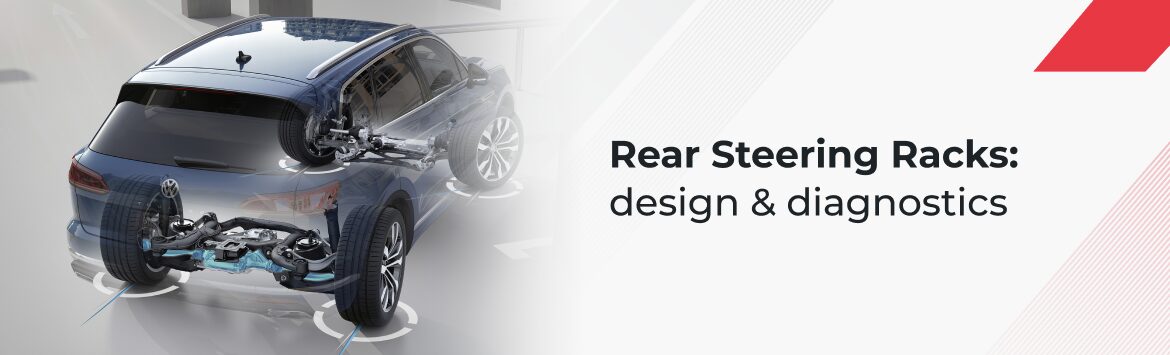
How rear steering racks steer the rear wheels by small angles, what their electromechanical design includes and how they are diagnosed with the MSG MS561 PRO.
Steering systems with two steered axles are becoming increasingly common on modern cars and SUVs. At their core is the rear steering rack, which has no mechanical link to the steering wheel and is driven by a control unit processing sensor and ESP data.
At low speeds (up to about 50 km/h) the rear wheels turn opposite to the front wheels, shrinking the turning circle and easing parking. At higher speeds they turn in the same direction by small angles, typically 2–5 degrees, improving stability during lane changes.
- Rack housing with guides and a brushless electric motor
- Ball screw reduction gear, position and angle sensors
- A usually integrated electronic control unit
MSG Equipment describes how these units are diagnosed using its MS561 PRO tester.